Proudly serving Phoenix, Glendale, Scottsdale, Tempe, Mesa, Chandler & surrounding areasCall or Text 24/7: 480-245-5233
Aerial drone view of the urban landscape, foothills, and residential sprawl in Phoenix, AZ.

24 Hour Towing and Emergency Roadside Assistance in Phoenix, AZ

Phoenix Towing Co. provides 24 hour towing across Phoenix and the surrounding metro. Our services include emergency towing, roadside assistance, and flatbed transport for breakdowns, collisions, and non-running vehicles. We also handle local and long-distance towing, motorcycle towing, jump starts, and car lockouts.

Phoenix heat, loose gravel shoulders, monsoon conditions, and heavy freeway traffic can turn a vehicle problem into a serious roadside risk. A live dispatcher collects your location, vehicle type, and problem so the right truck can start moving. Drivers assess drivetrain, clearance, and damage before choosing wheel-lift or flatbed transport, and they provide arrival updates when traffic affects the estimate.

With ambient temperatures climbing past 115 degrees and pavement temperatures past 160 degrees, breakdowns on I-10, I-17, and Loop 101 require prompt, safety-focused handling.

Phoenix Towing Co. provides 24 hour towing throughout Phoenix and the surrounding metro, including Scottsdale, Tempe, Mesa, Chandler, Gilbert, Glendale, Peoria, and Surprise.

★ ★ ★ ★ ★4.9/5 Average Rating · 20+ Years of Experience · Thousands of Customers Helped · Licensed & Insured · Residential & Commercial

24 Hour Towing Options & Benefits

What Is 24 Hour Towing?

24 hour towing keeps a live dispatcher and an available truck paired through rotating shifts, rather than relying on an after-hours voicemail or an on-call gap. Phoenix Towing Co. maintains that coverage every day of the year for towing and roadside requests across the metro.

Phoenix has more than 1.6 million residents spread across 517.9 square miles, so dispatch begins by identifying your cross streets or freeway mile marker, vehicle type, and the nature of the problem. That information helps match the call with nearby equipment instead of sending a truck across the city unnecessarily.

At the scene, the operator determines whether wheel-lift towing, flatbed transport, or roadside assistance is the safer response. Drivetrain type, ride height, visible damage, and roadside hazards all affect that decision.

Benefits of 24 Hour Towing

Round-the-clock coverage combines live communication, vehicle-specific handling, and equipment selected for Phoenix roads. The goal is to resolve the problem safely at the roadside when possible and arrange an appropriate tow when the vehicle should not continue.

  • Live dispatch and rotating truck coverage 24 hours a day
  • Proximity-based routing that accounts for Phoenix traffic
  • Direct arrival estimates, status updates, and a call five minutes before arrival
  • Wheel-lift or flatbed selection based on drivetrain, clearance, and damage
  • Roadside help for jump starts, lockouts, flat tires, and fuel delivery
  • Light and medium duty towing for sedans, SUVs, trucks, and vans
  • Synthetic recovery straps, wheel dollies, and traction mats for Valley shoulders
  • Commercial auto and cargo liability coverage on dispatched trucks
Phoenix Towing Services

Phoenix 24 Hour Towing Services

One dispatch line connects Phoenix drivers with towing, recovery, and roadside support for everyday breakdowns, accident scenes, specialty vehicles, and longer transports. Each request is matched to the vehicle condition and the equipment needed for safe handling.

Emergency Towing

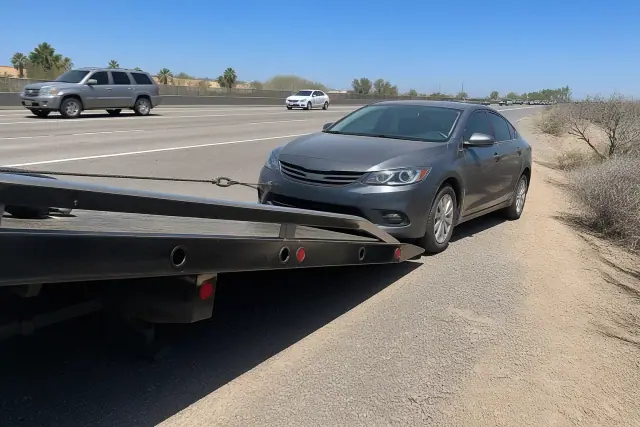
Disabled vehicle being recovered by a tow truck on a highway shoulder in Phoenix, AZ.

Emergency calls are routed by truck proximity instead of a strict queue. The dispatcher provides an arrival estimate and updates it when traffic, distance, a monsoon event, or a major freeway incident changes conditions.

Request Estimate

Roadside Assistance

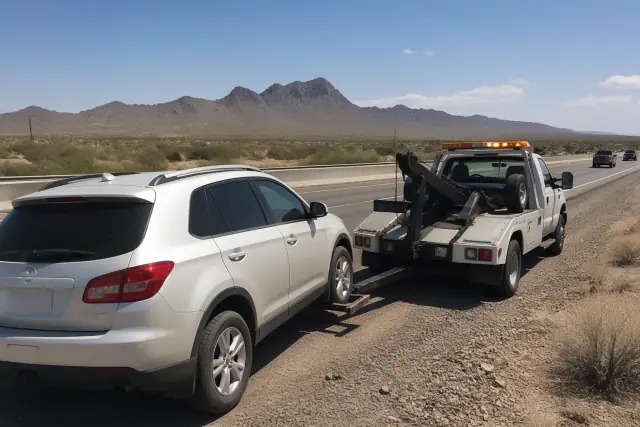
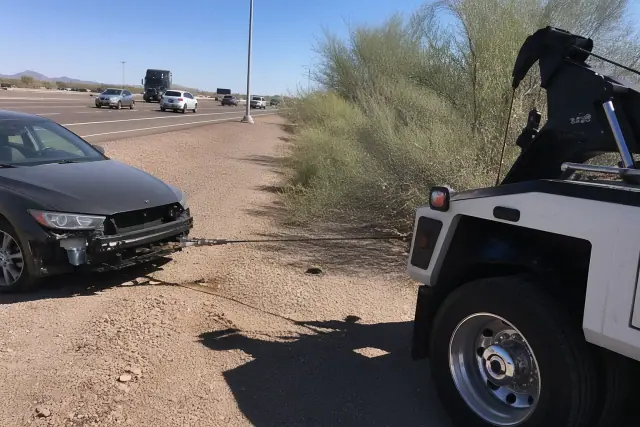
Tow truck hooked to a disabled vehicle on a roadside in Phoenix, AZ with mountain silhouettes in the background.

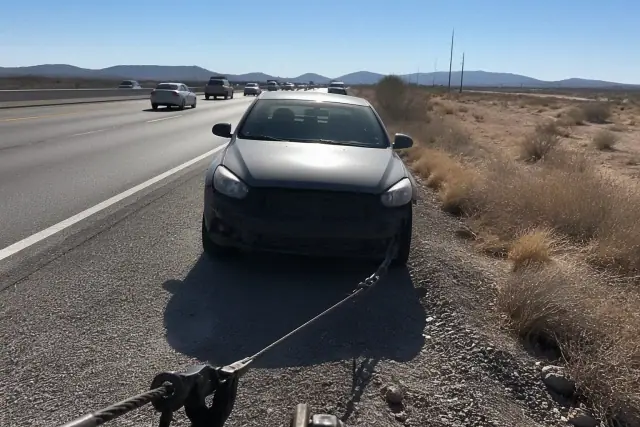
Jump starts, non-destructive car lockouts, tire changes, and fuel delivery can often resolve a breakdown without loading the vehicle. If overheating or another mechanical issue makes continued driving unsafe, the operator can arrange transport to a shop.

Request Estimate

Flatbed Towing

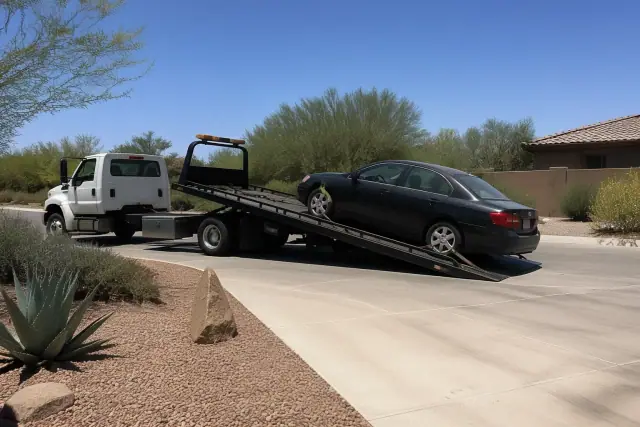
A passenger car being winched onto a flatbed tow truck on a concrete driveway in Phoenix, AZ.

Flatbed towing keeps every wheel off the road and is the default for all-wheel-drive vehicles, lowered cars, and vehicles with drivetrain or collision damage. Soft ties or wheel straps secure the vehicle without chains attached to the frame.

Request Estimate

Accident Recovery

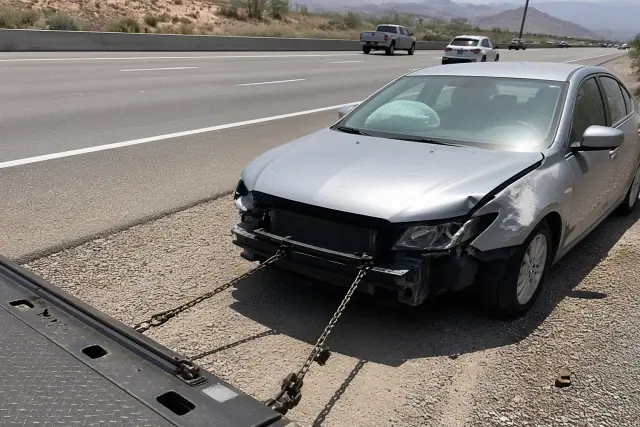
Damaged car with deployed airbags being secured by tow chains on a roadside in Phoenix, AZ.

Collision recovery starts with checking fluid leaks, suspension damage, airbag deployment, and whether the vehicle can move safely. Operators coordinate with responding officers when needed and use careful positioning to avoid adding damage during loading.

Request Estimate

Local and Long-Distance Towing

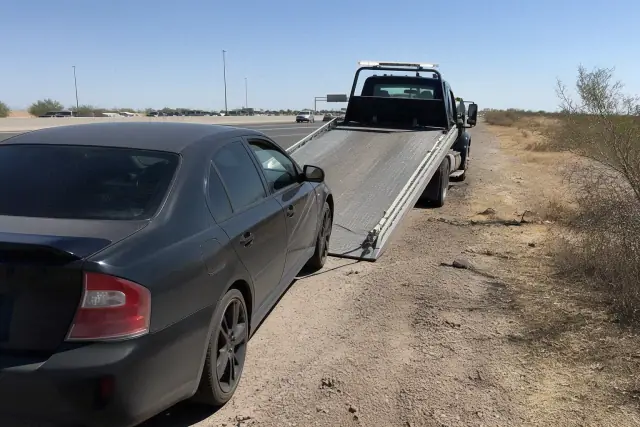
Tow truck loading a disabled vehicle on a highway shoulder in Phoenix, AZ.

Local requests are routed around current Phoenix traffic, while longer hauls include planned fuel stops, rest breaks, and road-condition checks. Vehicles remain flatbed-secured with periodic strap checks on multi-hour trips.

Request Estimate

Motorcycle and Specialty Vehicle Towing

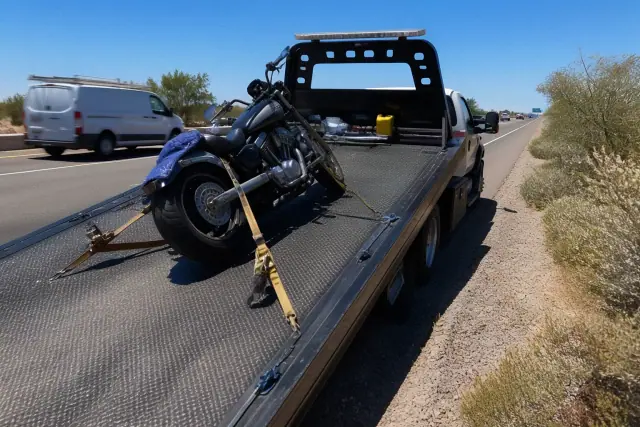
A motorcycle secured with ratchet straps on a tow truck bed on a roadside in Phoenix, AZ.

Motorcycles use a flatbed wheel chock and appropriate tie-down hardware for sportbikes and cruisers. Phoenix Towing Co. also handles classic, luxury, exotic, and all-terrain vehicles, while RV and trailer requests are assessed for the required weight rating and hitch setup.

Request Estimate
Towing and Recovery Options

Towing and Recovery Options

The safest method depends on the vehicle, its condition, the roadside setting, and the destination. Dispatch and the arriving operator use those details to choose wheel-lift towing, a full flatbed, roadside support, collision recovery, or specialty transport.

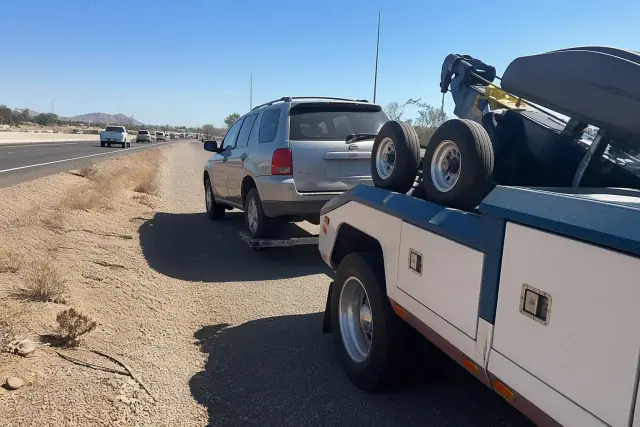
Wheel-lift tow truck recovering a disabled vehicle on a highway shoulder in Phoenix, AZ.

Wheel-Lift Towing

Wheel-lift towing raises the drive wheels while the other end rolls, making it suitable for many standard front-wheel-drive vehicles over short distances. The operator confirms drivetrain and condition before using this method.

  • Front-wheel-drive vehicles suitable for short-distance towing
  • Drive wheels lifted clear of the road
  • Vehicle type and drivetrain checked before hookup
  • Wheel dollies carried for compatible setups
  • Flatbed selected whenever wheel-lift transport creates risk
Request Estimate
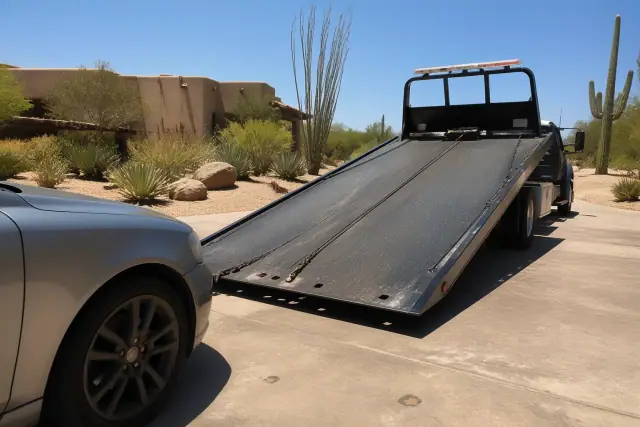
Flatbed tow truck loading a vehicle from a residential driveway in Phoenix, AZ, surrounded by desert landscaping.

Flatbed Transport

A flatbed carries the entire vehicle on an angled, winched deck so no wheels touch the road. It protects drivetrains and provides controlled loading for low-clearance or damaged vehicles.

  • All-wheel-drive vehicles kept fully off the road
  • Lowered cars loaded with ground clearance in mind
  • Soft ties or wheel straps instead of frame chains
  • Winched loading for non-running vehicles
  • Preferred transport for classic, luxury, and exotic cars
Request Estimate
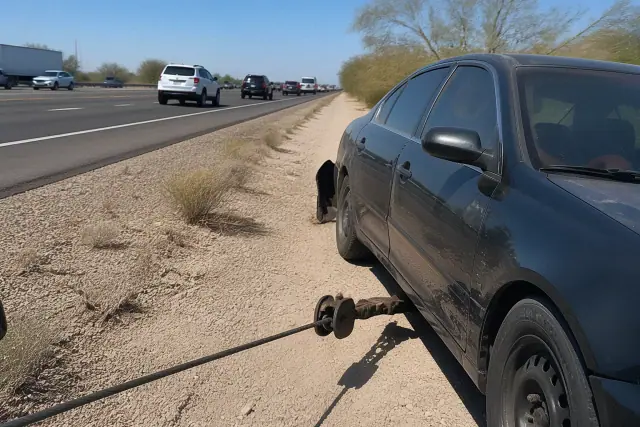
A disabled vehicle on a roadside gravel shoulder with a winch cable attached in Phoenix, AZ.

Roadside Assistance

Roadside support addresses problems that may not require a tow. The operator works curbside when the setting is safe and changes to towing when the vehicle cannot continue reliably.

  • Commercial-grade jump packs for drained batteries
  • Non-destructive tools for modern door and trunk locks
  • Tire changes for serviceable roadside situations
  • Fuel delivery when an empty tank caused the stop
  • Towing to a shop when roadside resolution is unsafe
Request Estimate
A disabled vehicle being pulled by a tow truck winch on a highway shoulder in Phoenix, AZ.

Accident Recovery

Accident recovery adapts the hookup and extraction plan to the vehicle damage and the scene. Fluid leaks, bent control arms, deployed airbags, debris, and traffic exposure can all change the approach.

  • Post-collision assessment before moving the vehicle
  • Containment mats used for fuel and fluid spills where possible
  • Careful flatbed positioning around damaged panels and frames
  • Coordination with responding law-enforcement officers
  • Transport to a body shop, home, or designated storage yard
Request Estimate
Tow truck loading a disabled vehicle on a highway shoulder in Phoenix, AZ.

Long-Distance and Specialty Towing

Long routes and specialty vehicles require more planning than a standard local tow. Equipment, vehicle weight, securement, road conditions, and route stops are reviewed before departure.

  • Arizona Department of Transportation road alerts checked for long routes
  • Fuel stops and driver rest breaks planned in advance
  • Periodic strap checks during multi-hour transport
  • Wheel chock system used for motorcycle towing
  • Weight ratings and hitch needs assessed for RVs and trailers
Request Estimate
A Safe Match for Your Vehicle

Choosing the Right Towing Approach

The right approach begins with honest details about the vehicle and the scene. All-wheel drive, low ground clearance, transmission or engine failure, collision damage, roadside debris, and transport distance help determine whether the call needs roadside help, wheel-lift towing, flatbed loading, or recovery equipment.

Shift-Staffed 24 Hour Dispatch

Drivers and trucks rotate through staffed shifts so coverage does not disappear after business hours. A 3 a.m. request follows the same dispatch process as a 3 p.m. request, including a live operator, equipment matching, and an arrival estimate.

Vehicle-Specific Equipment and Handling

Operators train on wheel-lift and flatbed hookup procedures, newer electric and hybrid towing modes, and light and medium duty recovery. Trucks carry J-hooks, axle straps, wheel nets, synthetic recovery straps, wheel dollies, and traction mats for the vehicle classes and roadside conditions described in the draft.

Phoenix-Aware Routing and Recovery

Dispatch accounts for congestion on Phoenix freeways and surface streets when choosing the nearest practical truck. Recovery equipment is also selected for loose gravel, sand shoulders, dust storms, and low-lying washes common across the Salt River Valley.

What Sets Us Apart

Why Choose Phoenix Towing Co. for Towing?

Phoenix Towing Co. combines continuous dispatch, vehicle-specific loading decisions, and communication from the first call through delivery. Operators follow Arizona Department of Transportation towing requirements, and each dispatched truck carries commercial auto and cargo liability coverage.

Request Towing

Heat-Related Battery and Cooling Failure

Phoenix heat shortens battery life and stresses radiator hoses and cooling systems. A battery that reads normally in April can fail by July, and local towing demand rises between June and August as overheating and battery problems become more common.

Tire Failure and Flat Tires

High pavement heat accelerates tire sidewall failure, while gravel shoulders can make a roadside tire change unstable. The operator handles the tire curbside when conditions are safe or arranges a tow when they are not.

Vehicle Lockouts

A lockout becomes a safety concern quickly when cabin temperatures can climb past 140 degrees within an hour. Technicians use non-destructive entry tools designed for modern door and trunk mechanisms to protect paint and weatherstripping.

Collision Damage and Fluid Leaks

A crashed vehicle may have leaking fluids, bent suspension parts, deployed airbags, or body damage that rules out ordinary towing. The recovery plan accounts for spill containment, safe extraction, and loading angles that do not worsen existing damage.

Engine, Starter, or Transmission Failure

A car that will not start may have a drained battery, a failed starter, transmission trouble, or engine failure. A jump start can solve a battery-only problem, but a vehicle with a deeper mechanical issue should be transported rather than driven.

Dust, Gravel, and Flooded Roads

Monsoon dust storms can reduce visibility to near zero, while loose shoulders and flash flooding near Salt River washes complicate recovery. Traction mats and synthetic recovery straps help operators work around sandy and gravel-heavy roadside conditions.

How It Works

Our 24 Hour Towing Process

Each call moves from location and vehicle details to equipment selection, clear communication, safe loading, and delivery. The process is designed to avoid mismatched trucks, unnecessary re-hooks, and preventable vehicle damage.

01.

Share Your Location and Vehicle Details

Provide your cross streets or freeway mile marker, vehicle type, and a brief description of the problem. Mention collision damage, low clearance, all-wheel drive, or specialty-vehicle needs so dispatch has the right context.

02.

Match the Truck and Equipment

Dispatch uses the vehicle and scene details to select wheel-lift, flatbed, roadside, or recovery equipment. The closest practical truck is routed with current traffic and location in mind.

03.

Receive an Arrival Estimate

The dispatcher provides a direct arrival estimate and updates it if distance or traffic changes the window. The driver calls or texts ahead, including a call when about five minutes away.

04.

Assess the Vehicle and Scene

The operator checks hookup type, load angle, drivetrain, ride height, damage, leaking fluid, debris, and traffic exposure. This roughly ten-minute assessment helps prevent delays and re-hooks after loading begins.

05.

Secure and Load the Vehicle

The operator positions the truck, winches the vehicle when needed, and secures it with appropriate wheel straps, nets, soft ties, or axle straps. Motorcycles use a wheel chock system built into the flatbed deck.

06.

Transport and Complete Delivery

The vehicle is taken to the agreed repair shop, home, body shop, or designated yard. Longer transports include checkpoint updates and periodic securement checks before delivery.

Get Help Now

Request 24 Hour
Towing in
Phoenix

Tell Phoenix Towing Co. where the vehicle is, what you drive, and what happened. Dispatch can match the call with appropriate towing or roadside equipment and provide an arrival estimate before the truck heads your way.

Towing Help

24 Hour Towing FAQs

These answers cover arrival estimates, towing methods, roadside help, pricing, accident response, specialty vehicles, and round-the-clock availability in Phoenix.

Call Phoenix Towing Co.

Arrival depends on your location, current traffic, and call volume across the metro. Dispatch sends the closest practical truck instead of following a strict queue, so central Phoenix may be reached sooner than far-outlying areas. You receive a realistic estimate and an update if conditions change.

A standard local tow in the Phoenix area typically falls between $85 and $160 within about 10 miles, with a base hook fee and a per-mile charge beyond that distance. Vehicle size, distance, time of day, and flatbed or specialty requirements can change the total. Phoenix Towing Co. provides a clear quote before dispatch, while storage is separate when a vehicle remains at a yard.

A flatbed carries the entire vehicle with every wheel off the road. Wheel-lift towing raises the drive wheels while the other end rolls, which can work for many standard front-wheel-drive vehicles on short trips. Phoenix Towing Co. defaults to flatbed when drivetrain, clearance, or existing damage makes wheel-lift transport risky.

Call 911 first when anyone is injured or the vehicles create an immediate traffic hazard. Once the scene is safe, Phoenix Towing Co. can coordinate accident towing with Phoenix Police Department or Arizona Department of Public Safety officers. The vehicle can be taken to a body shop, your home, or a designated storage yard as the situation allows.

Yes. Motorcycles are transported on a flatbed with a wheel chock system and appropriate tie-down hardware. Phoenix Towing Co. also handles classic, luxury, exotic, and all-terrain vehicles, while RV and trailer jobs are assessed for weight ratings and hitch requirements before dispatch.

The first question is whether the problem is a drained battery or a deeper mechanical failure. A commercial jump pack may get a battery-only problem running, but starter, engine, or transmission trouble usually calls for towing. If a jump does not hold, the vehicle can be taken to your preferred shop.

Yes. Phoenix Towing Co. operates 24 hours a day, every day of the year, including holidays. A 2 a.m. lockout follows the same dispatch and response process as a daytime request.

Provide your cross streets or freeway mile marker, vehicle type, and the nature of the problem. Details such as all-wheel drive, low clearance, collision damage, or a non-running vehicle help dispatch send appropriate equipment the first time.

Often, yes. Jump starts, lockouts, tire changes, and fuel delivery may be completed at the roadside when the setting is safe. If the vehicle is overheating or has a mechanical problem that makes driving unsafe, the operator can switch to towing.

All-wheel-drive systems can be damaged when some wheels roll while others are lifted, and lowered vehicles may not clear a wheel-lift setup safely. A flatbed keeps every wheel off the road and allows the operator to control the loading angle.

Depending on the situation, Phoenix Towing Co. can transport a vehicle to a repair shop, body shop, your home, or a police-designated storage yard. The destination is agreed during dispatch or coordinated with responding officers after a collision.

Long-distance jobs are planned around the route, fuel stops, driver rest breaks, and current Arizona Department of Transportation road alerts. The vehicle stays secured on the flatbed, with periodic strap checks during multi-hour travel. Updates are provided at major checkpoints.

Extreme heat increases battery, cooling-system, and tire failures, while monsoon dust, flooding, and collision volume can complicate access. Dispatch factors traffic and road conditions into the arrival estimate. Trucks carry traction mats and recovery straps for loose sand and gravel shoulders.