Proudly serving Phoenix, Glendale, Scottsdale, Tempe, Mesa, Chandler & surrounding areasCall or Text 24/7: 480-245-5233
Aerial drone view of the urban landscape, foothills, and residential sprawl in Phoenix, AZ.

Local Towing Services for Breakdowns & Vehicle Transport in Phoenix, AZ

Phoenix Towing Co. provides local towing throughout Phoenix, Arizona, with 24 hour dispatch for breakdowns, collisions, and scheduled vehicle moves. Our services include emergency towing, roadside assistance, flatbed towing, long distance transport, accident recovery, motorcycle towing, jump starts, and car lockout help. GPS-tracked wheel-lift and flatbed trucks are staged around the Valley to route the nearest available operator.

On an August afternoon, Phoenix pavement can reach 140 degrees, increasing the risk of tire, battery, and cooling-system trouble. Our operator assesses drivability, transmission condition, and approach angle before choosing a wheel-lift or flatbed. Because we are a family-owned towing operation instead of a call center reselling jobs, the GPS-tracked truck assigned by dispatch is the truck that arrives.

Dispatch provides a realistic ETA and quotes the towing price before a truck leaves, while real-time tracking supports clear updates if traffic changes the route.

Phoenix Towing Co. provides local towing in Phoenix and across the Valley of the Sun, including Tempe, Mesa, Chandler, Scottsdale, Glendale, Peoria, and San Tan Valley.

★ ★ ★ ★ ★4.9/5 Average Rating · 20+ Years of Experience · Thousands of Customers Helped · Licensed & Insured · Residential & Commercial

Local Towing Options & Benefits

What Is Local Towing?

Local towing moves a disabled, damaged, or non-drivable vehicle from its Phoenix pickup point to a nearby shop, home, or safe location. Dispatch matches the closest available truck to the vehicle type and situation rather than using a rigid rotation.

At the scene, the operator checks whether the vehicle can roll, steer, and brake normally, then selects hydraulic wheel-lift or flatbed equipment. All-wheel-drive, low-clearance, specialty, and collision-damaged vehicles may need a flatbed or particular rigging to limit drivetrain or body damage.

Phoenix coverage spans 517.9 square miles and serves a city of more than 1.6 million residents, so staged truck placement matters for pickups near downtown, Midtown, Sky Harbor, Desert Ridge, Laveen, Arcadia, the Biltmore area, and the surrounding Valley.

Benefits of Local Towing

A properly planned local tow combines fast routing, equipment suited to the vehicle, clear communication, and secure transport from pickup through delivery.

  • Multi-zone truck staging reduces unnecessary drive time to the pickup.
  • GPS tracking supports realistic ETAs and traffic-delay updates.
  • Upfront quotes explain the hookup fee, mileage, and equipment needs.
  • Wheel-lift or flatbed selection follows an on-scene vehicle assessment.
  • Soft-tie wheel straps avoid chains on rims and suspension components.
  • Flatbeds keep all four wheels off the pavement when needed.
  • Condition photos document the vehicle before and after transport.
  • Delivery can be made to your shop, home, or nearest safe location.
Phoenix Towing Services

Phoenix Local Towing Services

From a short trip across town to a collision recovery or long-distance vehicle move, each service starts with the vehicle, location, and road conditions so dispatch can send suitable equipment.

Emergency Towing

A tow truck prepares to load a disabled vehicle on a highway shoulder in Phoenix, AZ.

Around-the-clock dispatch handles vehicles stranded on freeway shoulders, in intersections, or after unexpected breakdowns, including a 2 a.m. shift-worker commute. A call at 3 a.m. receives the same dispatch process as one at 3 p.m. The dispatcher gathers your location, vehicle type, and situation, provides a realistic ETA, and routes the nearest available truck.

Request Estimate

Roadside Assistance

Tow truck preparing a disabled vehicle on a gravel shoulder on a sunny highway in Phoenix, AZ.

Many calls can be resolved without a tow. Roadside help covers jump starts, non-destructive car lockout service, fuel delivery, and spare-tire changes so the vehicle can get moving again at the scene when conditions allow.

Request Estimate

Flatbed Towing

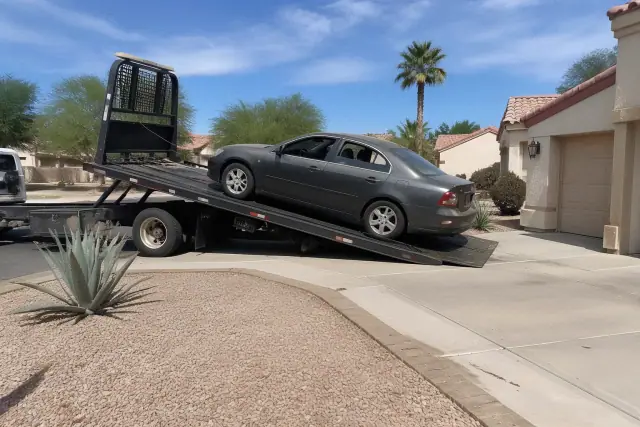
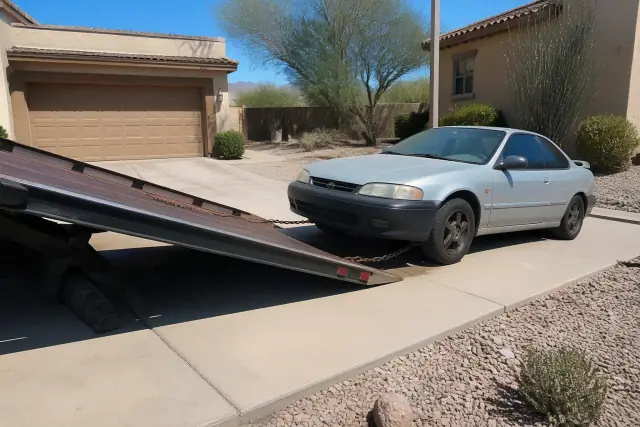
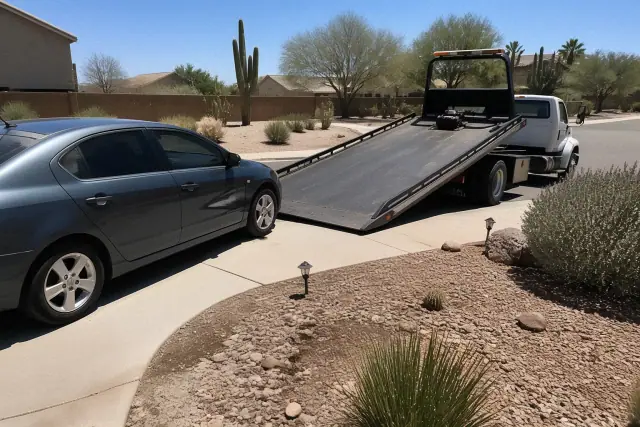
A vehicle being winched onto a flatbed tow truck on a residential driveway in Phoenix, AZ.

Flatbed towing carries the full vehicle with every wheel off the pavement. Low-clearance loading equipment, approach-angle checks, and weight-rated soft-tie straps protect all-wheel-drive vehicles, lowered cars, luxury or exotic models, and classics during loading and transport.

Request Estimate

Long Distance Towing

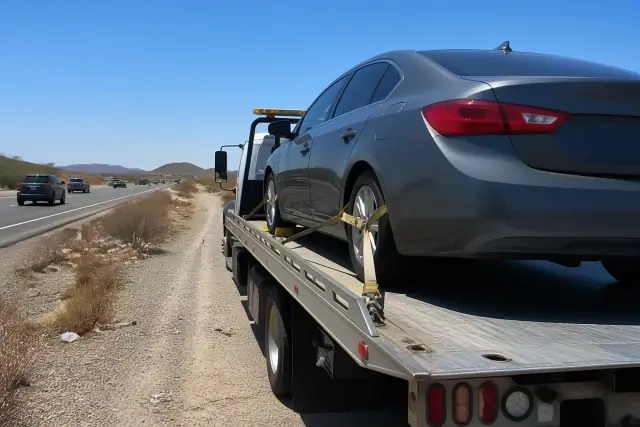
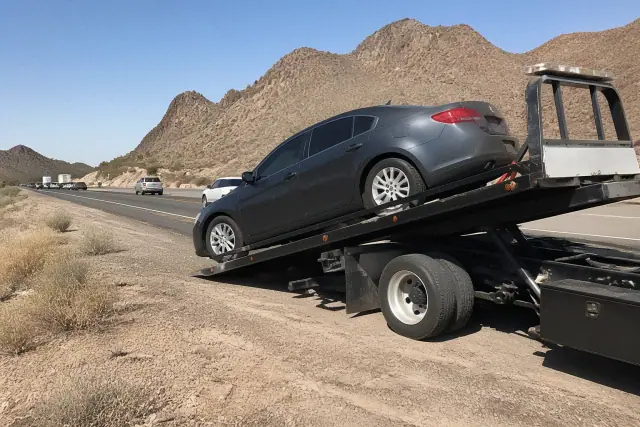
A disabled vehicle secured by straps and chocks on a flatbed tow truck on a highway shoulder in Phoenix, AZ.

Long-distance service moves vehicles between Phoenix, Tucson, Flagstaff, and supported routes into California or Nevada. Route planning accounts for desert heat, while GPS tracking, an arrival window, a bill of lading, and condition documentation support the extended transport.

Request Estimate

Motorcycle Towing

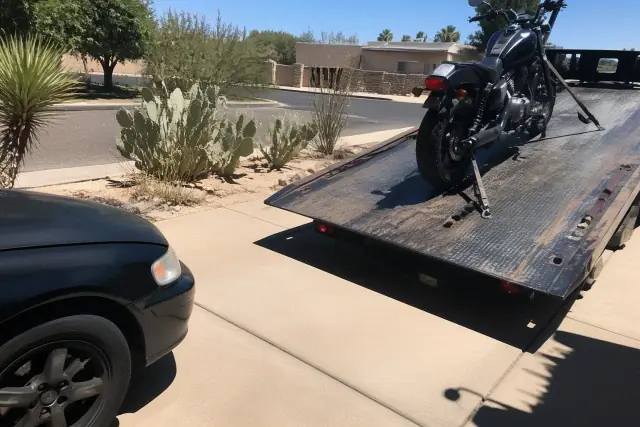
A motorcycle secured with tie-downs on a tow truck bed in a residential driveway in Phoenix, AZ.

Motorcycle towing uses dedicated wheel chocks, low-angle ramps, and soft-loop tie-downs anchored to the frame rather than the handlebars or fork tubes. Operators account for the different geometry of cruiser, sport, and touring motorcycles during loading.

Request Estimate

Accident Recovery

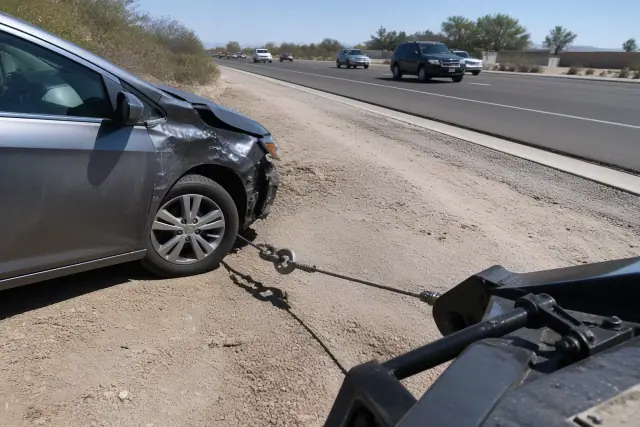
Disabled vehicle with a crumpled fender and towing hook on a gravel shoulder of a roadway in Phoenix, AZ.

Collision recovery addresses vehicles that may not roll, steer, or brake normally. Crews assess scene hazards, set out cones, warning triangles, and lighting, coordinate with responding officers when applicable, and prepare documentation for insurance-related transport.

Request Estimate
Vehicle & Roadside Needs

Towing & Roadside Options

The right response may be a quick roadside fix, a nearby tow, a flatbed for a sensitive vehicle, or higher-capacity recovery equipment. These service groups show how the vehicle and situation shape the dispatch plan.

A disabled vehicle being winched onto a hydraulic tow truck on a desert highway shoulder in Phoenix, AZ.

Local & Emergency Towing

Continuous dispatch and staged trucks support short local moves, after-hours breakdowns, and urgent pickups across Phoenix. A standard local tow within 5 to 10 miles typically runs $75 to $125, depending on distance and vehicle type.

  • Dispatch operates every day of the year.
  • Multiple staging points serve the Phoenix metro.
  • Short trips can end at a shop, home, or safe location.
  • Freeway, intersection, and parking-lot pickups are supported.
  • Price and ETA are provided before the truck leaves.
Request Estimate
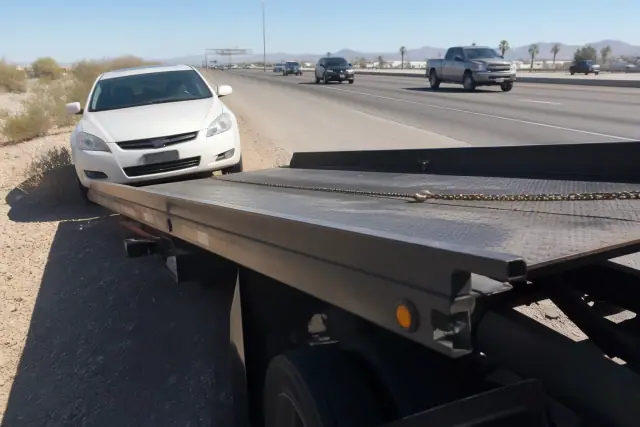
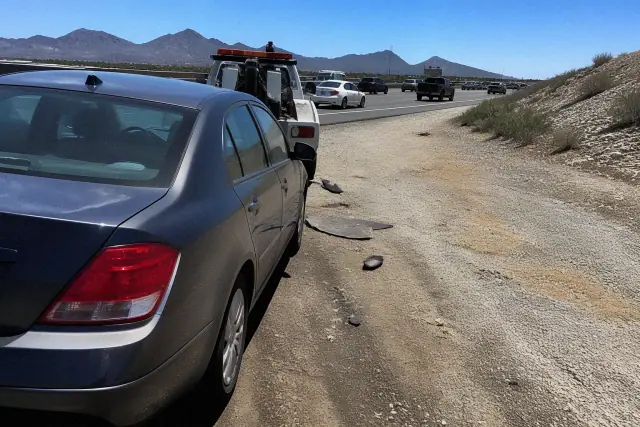
A disabled vehicle parked on the gravel shoulder of a Phoenix, AZ road with mountain views in the background.

On-Site Roadside Assistance

Roadside assistance focuses on resolving common problems where the vehicle sits, avoiding a tow when the issue can be handled safely on-site. With a usable spare available, a tire change can get a driver moving in under thirty minutes in most cases.

  • Jump starts for heat-stressed or dead batteries
  • Non-destructive vehicle lockout service
  • Fuel delivery to reach the nearest station
  • Spare-tire installation after a flat or blowout
  • A tow recommendation when on-site help is not enough
Request Estimate
Vehicle being winched onto a flatbed tow truck in a residential driveway in Phoenix, AZ.

Flatbed & Specialty Transport

Flatbed and specialty equipment addresses vehicles whose drivetrains, body clearance, or two-wheel geometry require more than a routine wheel-lift. The operator checks ride height, weight class, and securement points before loading.

  • All-wheel-drive vehicle transport
  • Low-clearance, exotic, luxury, and classic cars
  • Motorcycle chocks and low-angle loading ramps
  • Soft ties on wheels or motorcycle frames
  • Pre- and post-transport condition photos
Request Estimate
A vehicle parked on a residential driveway in Phoenix, AZ, being winched onto a tow truck bed.

Long Distance Vehicle Transport

Long-distance pricing follows the route, mileage, and vehicle class rather than the logic of a short tow across town. A 20 to 40 mile Phoenix tow is described in the source at roughly $185 to $285, while a move of 100 or more miles can run $600 or more depending on the vehicle and route.

  • Inter-city and supported multi-state routes
  • Route planning for desert highway heat
  • GPS-tracked progress and arrival windows
  • Bill of lading and vehicle condition records
  • Coordination with approved insurance towing benefits
Request Estimate
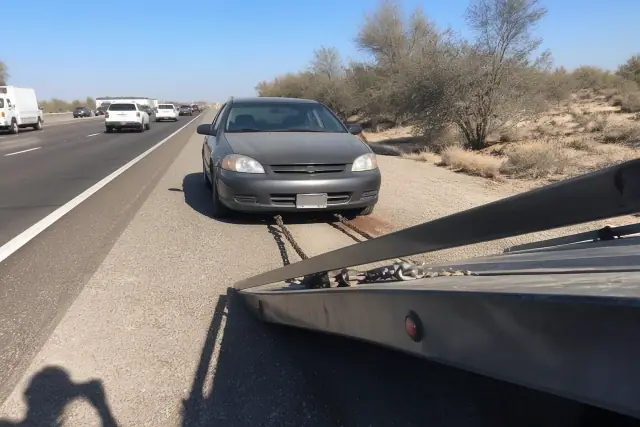
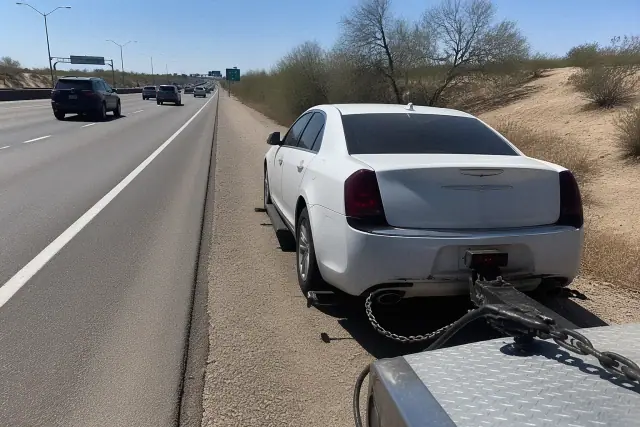
Disabled vehicle on the shoulder of a highway in Phoenix, AZ, with visible recovery chains and cables.

Accident & Commercial Recovery

Higher-capacity winches and recovery knowledge support damaged passenger vehicles as well as box trucks, delivery vans, and medium-duty fleet vehicles. Crews also handle winch-outs from desert washes, soft shoulder sand, canal-adjacent embankments, and water-damage situations after monsoon flooding.

  • Recovery for vehicles that cannot roll, steer, or brake
  • Light-, medium-, and heavy-duty synthetic winch line
  • Air-brake knowledge for supported commercial vehicles
  • Off-road and difficult-location winch-outs
  • Cones, warning triangles, and scene lighting
Request Estimate
Matching Truck to Vehicle

Choosing the Right Towing Approach

The safest towing approach depends on the vehicle's drivetrain, ride height, weight, condition, and pickup access. Dispatch gathers the basic details first, and the operator confirms the wheel-lift, flatbed, rigging, or recovery method after assessing the vehicle at the scene.

Multi-Zone GPS Dispatch

Trucks are staged at multiple points around Phoenix, and the dispatch board matches the closest available unit to the call. GPS tracking lets dispatch follow progress and communicate route changes caused by I-10, I-17, Loop 101, or Loop 202 traffic.

Vehicle-Specific Equipment

Hydraulic wheel-lift and flatbed rigs, synthetic winch line, low-angle ramps, wheel straps, and motorcycle-specific chocks allow the operator to match equipment to the vehicle. Tie-down training focuses on secure transport without placing chains directly on rims or suspension parts.

Family-Owned Direct Service

Calls stay with the family-owned towing operation instead of being resold by a call center to a subcontractor. The assigned driver and truck remain visible to dispatch, supporting clearer accountability from the initial call through delivery.

Clear Dispatch & Careful Transport

Why Choose Us for Local Towing?

Phoenix Towing Co. combines direct dispatch, staged GPS-tracked trucks, vehicle-specific towing equipment, and upfront price information. Operators assess the vehicle before loading, secure it using appropriate contact points, and document condition when the transport calls for it.

Request Estimate

Heat-Stressed Batteries

Extreme desert temperatures stress lead-acid batteries and contribute to summer dead-battery calls. Jump-start service can often get a vehicle running where it is parked, while a tow remains available if the vehicle will not restart reliably.

Pavement-Heat Tire Blowouts

Hot summer pavement contributes to frequent flat-tire and blowout calls around Phoenix. If the vehicle has a usable spare and can be handled safely at the scene, roadside assistance can replace the tire; otherwise dispatch can arrange a tow.

Overheated Engines

Radiators and cooling systems can be overwhelmed during Phoenix heat, leaving vehicles stalled on busy corridors. An operator checks drivability at the scene and transports an unsafe vehicle rather than adding stress by trying to keep it moving.

Lockouts and Empty Tanks

Locked keys and an empty fuel tank do not always require a full tow. Technicians use non-destructive entry tools for modern lock systems, and fuel delivery provides enough gasoline to reach the nearest station.

Collision-Damaged Vehicles

After a collision, a vehicle may have damaged steering, brakes, suspension, or wheels that make routine loading unsafe. Recovery crews evaluate how it can move, protect the scene, and document the tow for insurance when applicable.

Desert and Monsoon Recovery

Monsoon flooding, soft shoulder sand, desert washes, and canal-adjacent embankments can leave a vehicle beyond the reach of a basic tow setup. Winch-out and off-road recovery methods address difficult access and water-damaged vehicles around Phoenix's outer areas.

How It Works

Our Local Towing Process

Each call moves through the same core sequence: gather accurate details, route suitable equipment, assess the scene, secure the vehicle, and complete transport with clear communication.

01.

Share Your Location and Vehicle Details

Tell dispatch where the vehicle is, what type it is, where it needs to go, and whether it can roll, steer, or brake. These details help identify the truck and equipment the call is likely to require.

02.

Receive Your Quote and ETA

Dispatch quotes the expected towing price and provides a realistic arrival estimate before the truck leaves. The quote accounts for pickup access, destination distance, vehicle class, and whether flatbed or recovery equipment is needed.

03.

Nearest Available Truck Is Routed

The dispatch board checks staged units around the metro and sends the nearest suitable truck. GPS tracking supports progress updates if freeway congestion or a Loop 202 backup changes the route.

04.

Operator Assesses the Vehicle

At the scene, the operator confirms drivability, transmission condition, ride height, damage, and access. That assessment determines whether a wheel-lift, flatbed, specialty loading setup, or recovery technique is appropriate.

05.

Vehicle Is Loaded and Secured

The operator checks the loading angle, places straps on appropriate securement points, and avoids chains directly on rims or suspension components. Motorcycles use a dedicated chock and frame-mounted soft loops.

06.

Transport and Delivery Are Completed

The vehicle travels to the agreed shop, home, or safe destination. For collision and extended transports, condition photos, insurance-related records, or a bill of lading are provided when applicable.

Get Towing Help

Request Phoenix Towing Help

Share your pickup location, vehicle type, condition, and destination to receive an equipment recommendation, realistic ETA, and price before dispatch.

Phoenix Towing Help

Local Towing FAQs

These answers cover Phoenix towing costs, roadside and flatbed options, dispatch details, service coverage, and common questions about vehicle removal.

Call Our Experts

Local Phoenix tows of 5 miles or less generally run $85 to $125, while a 20 to 40 mile tow is generally $185 to $285. Vehicle size, pickup access, time of day, and whether flatbed or wheel-lift equipment is needed affect the final price. Phoenix Towing Co. quotes the pickup-to-destination price before the truck leaves.

Most local tows under 20 miles cost between $75 and $250. The source breaks that into a base hookup fee of roughly $35 to $100 plus about $2.50 to $7 per mile, with vehicle weight, access, and flatbed requirements affecting the total. Dispatch explains the applicable line items before sending a truck.

The Arizona Department of Public Safety Tow Service Program sets standards for removing disabled and abandoned vehicles from state highways. Private-property towing is also subject to Arizona notice, signage, and fee rules, while Phoenix maintains its own contracts and procedures for certain city-street and impound tows. The rules that apply depend on where and why the vehicle was removed.

The term is generally used in trailer weight and load-distribution discussions, where part of a trailer's total weight rests on the tow vehicle's hitch. It does not apply in the same way to commercial vehicle recovery, where a disabled car is carried on a flatbed or partially lifted. Trailer-capacity questions require a different calculation from a car recovery tow.

For a vehicle removed from a city street or by police order, contact the City of Phoenix Police Department's vehicle towing information line for the recorded impound location. For a private-property tow, check the property's posted towing sign for the towing company's name and phone number. If Phoenix Towing Co. handled a requested tow, dispatch can confirm the drop-off location.

Private-property towing generally requires visible posted notice, while public authorities may order removal without advance owner notice when a vehicle is abandoned, blocking traffic, or involved in a collision. Highway and municipal tows follow the rules for the authority and location involved. The towing company should provide documentation and dispute contact information when required.

A jump start, non-destructive lockout, limited fuel delivery, or spare-tire change can often be completed at the vehicle's location. The operator recommends a tow when the vehicle will not restart reliably, lacks a usable spare, or cannot be handled safely at the scene.

Flatbed towing is well suited to all-wheel-drive vehicles, low-clearance sports cars, luxury or exotic models, classics, and vehicles with damage that makes wheel-lift transport unsuitable. The operator checks drivetrain condition, ride height, loading angle, and vehicle damage before selecting the setup.

A flatbed can keep every wheel off the pavement and avoid rolling a sensitive drivetrain on one axle. The vehicle is secured with weight-rated soft-tie wheel straps rather than chains placed directly on rims or suspension parts, and the loading angle is checked before winching.

Motorcycle transport uses a dedicated front-wheel chock and a low-angle loading ramp. Soft-loop tie-downs anchor to the frame instead of the handlebars or fork tubes, helping prevent bent forks, stretched cables, or fairing damage during transport.

Yes. Long-distance transports remain GPS tracked so dispatch can provide progress updates and an arrival window. The service also includes a bill of lading and vehicle condition documentation for the extended move.

Provide the pickup location, vehicle type, current condition, destination, and whether the vehicle can roll, steer, or brake. Those details let dispatch identify likely equipment needs, quote the trip, provide an ETA, and route a suitable nearby truck.

Service covers Phoenix and the greater Valley of the Sun, including Tempe, Mesa, Chandler, Scottsdale, Glendale, Peoria, and San Tan Valley. Within Phoenix, the draft also names downtown, Midtown, the Sky Harbor corridor, Ahwatukee, Desert Ridge, Laveen, Arcadia, and the Biltmore area.