Proudly serving Phoenix, Glendale, Scottsdale, Tempe, Mesa, Chandler & surrounding areasCall or Text 24/7: 480-245-5233
Aerial drone view of the urban landscape, foothills, and residential sprawl in Phoenix, AZ.

Flatbed Towing for AWD, Motorcycles & Low-Clearance Vehicles in Phoenix, AZ

Phoenix Towing Co. provides flatbed towing in Phoenix for drivers across a 517.9-square-mile city with more than 1.6 million residents. Our single dispatch operation also handles 24-hour towing, emergency towing, roadside assistance, local and long-distance towing, accident recovery, and motorcycle transport. Jump starts and car lockout service are available when a tow is not necessary. We move cars, trucks, SUVs, motorcycles, and non-running vehicles with equipment selected for the situation.

Phoenix summer air can reach 115+ degrees in July, while asphalt surface temperatures routinely exceed 150 degrees. A fully raised flatbed avoids adding tire, transmission, or suspension strain to a heat-stressed vehicle. Hydraulic lift beds, multi-point straps rated for the vehicle's full weight, soft wheel ties, and controlled winching protect vehicles with all-wheel drive, low clearance, or existing damage. GPS-tracked dispatch identifies the closest available flatbed and provides a real arrival window.

Dispatch is available 24/7, with the same rate structure at night, on weekends, and on holidays.

Phoenix Towing Co. provides flatbed towing across Phoenix and the surrounding metro, including Scottsdale, Tempe, Mesa, Glendale, and Chandler.

★ ★ ★ ★ ★4.9/5 Average Rating · 20+ Years of Experience · Thousands of Customers Helped · Licensed & Insured · Residential & Commercial

Flatbed Towing Options & Benefits

What Is Flatbed Towing?

Flatbed towing carries the entire vehicle on a hydraulically operated deck rather than pulling it with two wheels on the road. The bed tilts to street level, the vehicle is driven or winched aboard, and the deck returns to a level transport position.

Four-point strapping secures the load while all four tires remain off the pavement. This arrangement prevents contact between the tow mechanism and the vehicle's frame, bumper, or road-facing tires.

The method is well suited to all-wheel-drive vehicles, low-clearance cars, motorcycles, non-running vehicles, and collision-damaged vehicles. The same flatbed equipment supports local towing, long-distance towing, and accident recovery without switching equipment mid-call.

Benefits of Full-Deck Transport

Keeping the vehicle fully off the road limits additional stress during transport and gives the operator a controlled platform for securing different vehicle types.

  • All four wheels remain off the pavement
  • Soft wheel ties avoid chains on the frame or bumper
  • Four-point strapping controls movement on the deck
  • AWD and 4WD drivetrains remain fully lifted
  • Deck padding protects low-clearance loading points
  • Controlled winching moves non-running vehicles
  • Sedans, SUVs, trucks, and motorcycles can be carried
  • One deck supports local, long-distance, and recovery calls
Phoenix Vehicle Transport

Phoenix Flatbed Towing Services

Flatbed service covers planned vehicle transport and urgent roadside situations throughout Phoenix. Dispatch selects the equipment and loading approach from the vehicle type, location, operating condition, and existing damage reported on the call.

24-Hour Flatbed Towing

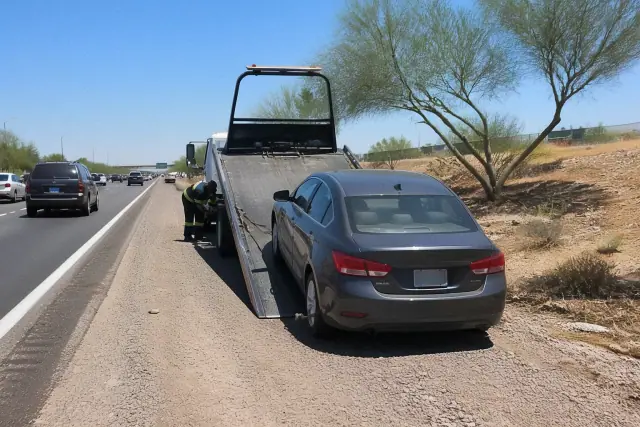
Flatbed tow truck loading a disabled vehicle on a gravel highway shoulder in Phoenix, AZ.

The 24/7 dispatch operates every day of the year for breakdowns, night calls, weekends, and holidays. The closest available GPS-tracked flatbed is assigned from coverage points across the metro, with operators reporting in real time for a current ETA.

Request Estimate

Emergency and Accident Recovery

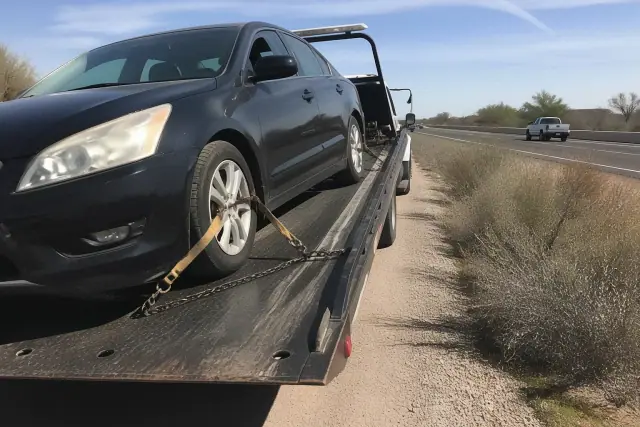
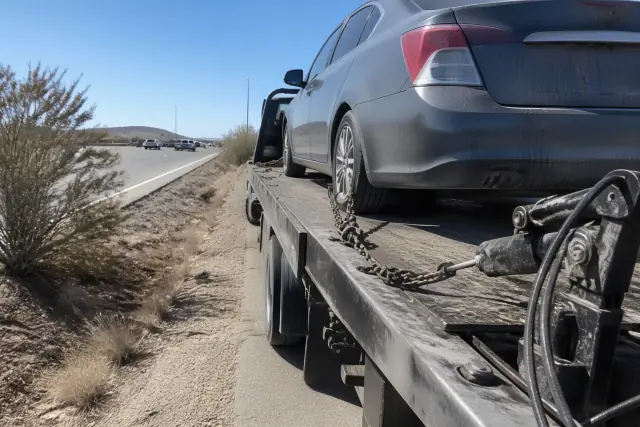
A disabled vehicle secured on a flatbed tow truck on a gravel shoulder in Phoenix, AZ.

Emergency calls include freeway breakdowns, collision scenes, and vehicles stranded on unstable ground. Operators assess structural damage, leaking fluids, airbag deployment, and the safest winching path before loading, while freeway-shoulder calls receive priority because of secondary-collision risk.

Request Estimate

Local and Long-Distance Towing

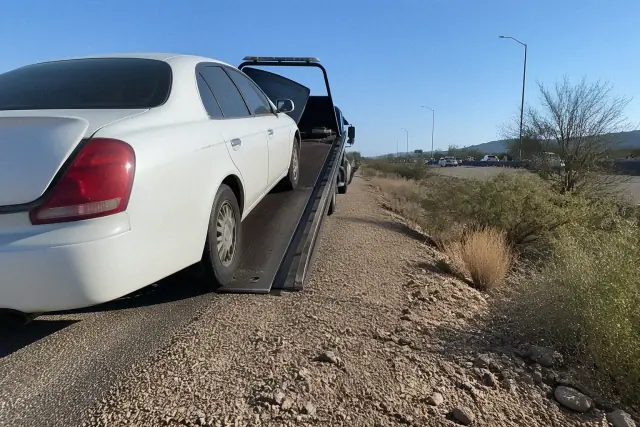
Flatbed tow truck loading a disabled vehicle on a roadside in Phoenix, AZ, under bright desert sunlight.

Flatbeds handle short moves to Phoenix repair facilities and long-distance transport beyond the metro. The fully supported deck avoids two-wheel road contact, and straps are rechecked when a long-distance tow runs more than 30 minutes.

Request Estimate

Luxury and Exotic Car Transport

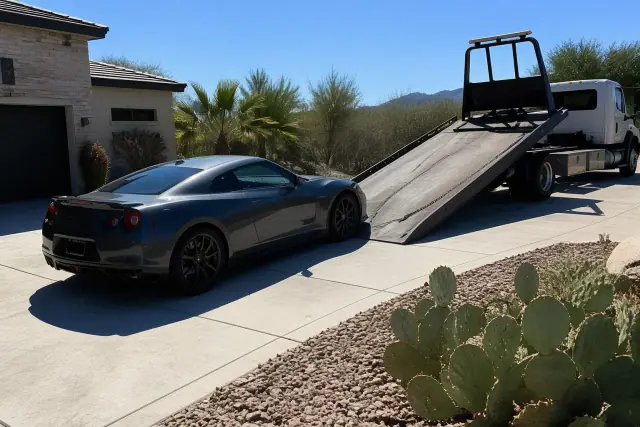
Luxury car being winched onto a flatbed tow truck on a residential driveway in Phoenix, AZ.

Low-slung luxury and exotic vehicles are loaded with extended ramp angles, shallow deck positioning, and extra padding. Soft straps are placed at factory-approved points to protect the finish, front splitter, rear diffuser, and undercarriage panels.

Request Estimate

Motorcycle Towing

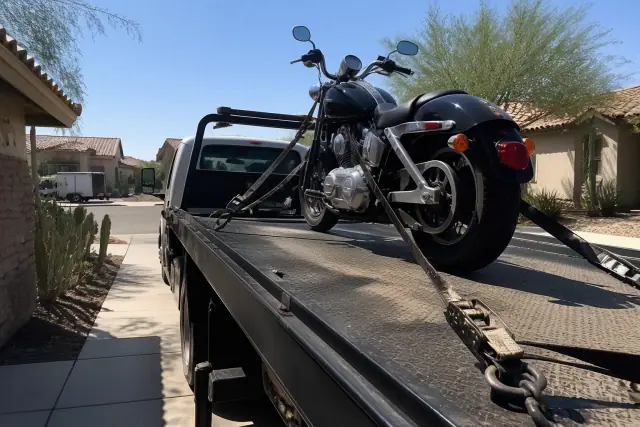
A motorcycle securely strapped to a flatbed tow truck on a residential driveway in Phoenix, AZ.

Motorcycles are stabilized with a wheel chock bolted to the flatbed deck and four-point straps attached at suitable frame points. Dedicated chocks provide controlled support where a motorcycle cannot rely on its kickstand, including across windy open-desert freeway stretches.

Request Estimate

Non-Running Vehicle Towing

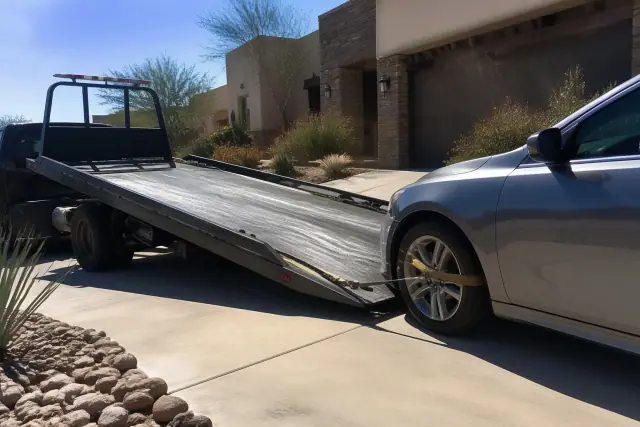
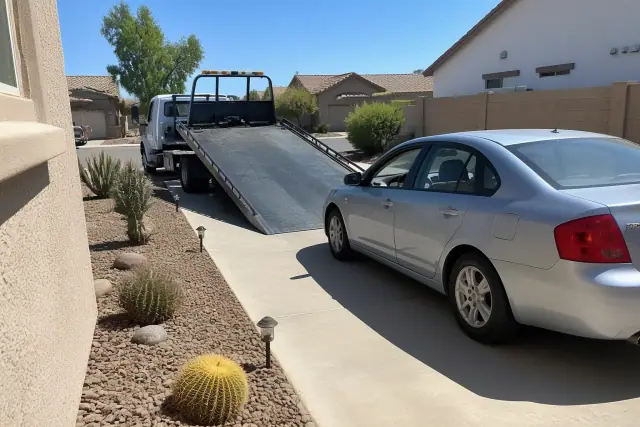
Disabled sedan being winched onto a flatbed tow truck on a residential driveway in Phoenix, AZ.

A vehicle that will not start or shift out of park can be moved with a controlled cable winch. Loading without pushing or dragging limits additional stress on the transmission and brake lines while the deck supplies a stable transport surface.

Request Estimate
Transport Details

Flatbed Towing Methods, Vehicles & Rates

The right flatbed approach depends on how the vehicle runs, its clearance and drivetrain, the pickup environment, and the distance to its destination. Phoenix Towing Co. confirms these details during dispatch so the operator arrives prepared to load and secure the vehicle.

Vehicle secured with nylon tie-down straps on a flatbed tow truck in a driveway in Phoenix, AZ.

Controlled Loading and Tie-Downs

Hydraulic deck positioning, cable winching, soft ties, and pre-transport checks create a controlled loading sequence for operable and non-running vehicles.

  • Hydraulic bed tilts down to street level
  • Controlled winch loads vehicles that cannot move
  • Soft wheel ties replace frame or bumper chains
  • Straps are torque-checked before transport
  • Long-distance loads are rechecked after more than 30 minutes
Request Estimate
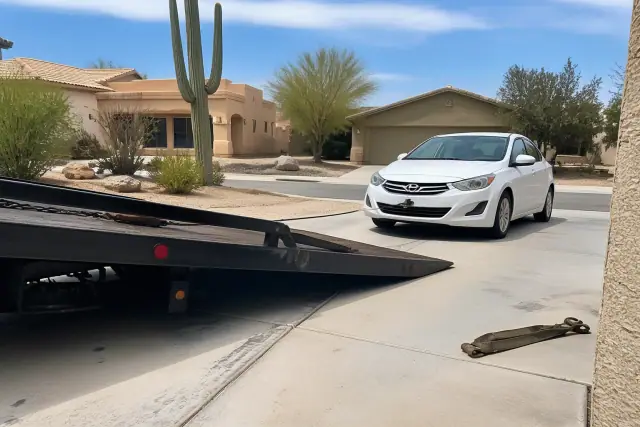
Vehicle on a flatbed tow truck in a residential driveway in Phoenix, AZ.

Passenger and Specialty Vehicles

Flatbed decks support everyday passenger vehicles and specialty transports when the truck class matches the vehicle's weight and loading needs.

  • Sedans and SUVs
  • Pickup trucks and heavier vehicles
  • All-wheel-drive and four-wheel-drive vehicles
  • Luxury and low-clearance cars
  • Motorcycles with dedicated wheel chocks
Request Estimate
A disabled vehicle being winched onto a flatbed tow truck on a gravel roadside in Phoenix, AZ.

Accident and Terrain Recovery

Recovery calls combine careful vehicle assessment with cable winching to bring a damaged or stuck vehicle onto stable ground and then onto the flatbed.

  • Desert washes and gravel shoulders
  • Unpaved parking areas
  • Collision-damaged frames and deployed airbags
  • Containment mats for leaking fluids
  • Officer and insurance arrangement confirmation
Request Estimate
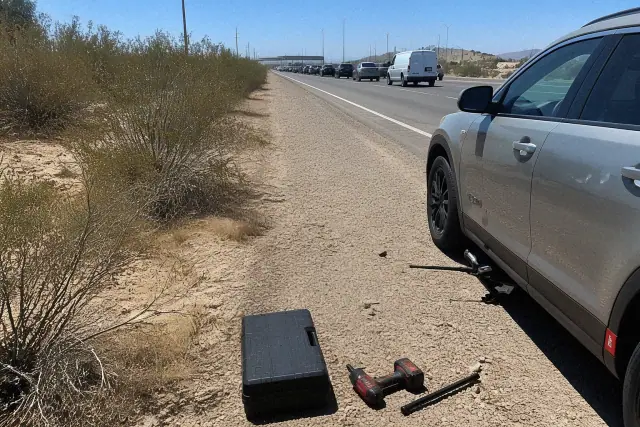
Disabled vehicle on a highway shoulder with roadside tools in Phoenix, AZ.

Roadside Help Without a Tow

Not every breakdown needs flatbed transport. The same dispatch can send roadside assistance intended to get the vehicle moving again when the problem can be handled on scene.

  • Jump starts with calibrated jump packs
  • Non-destructive car lockout entry
  • Minor mechanical breakdown assistance
  • One phone number for towing and roadside calls
  • Identical 24/7 dispatch queue for nights and weekends
Request Estimate
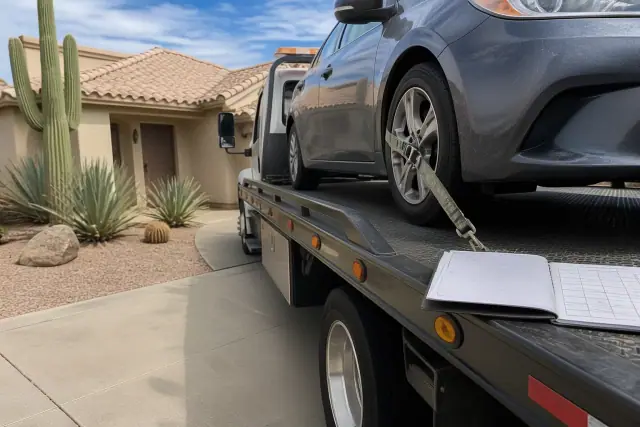
A vehicle secured on a flatbed tow truck in a residential driveway in Phoenix, AZ, with a clipboard on the bed.

Transparent Phoenix Towing Rates

The stated rate structure uses a $95 hook fee plus $6 per loaded mile, with no added night, weekend, or holiday surcharge. The total is provided before the truck arrives.

  • 5 miles or less typically costs $85 to $125
  • 10-20 miles typically costs $135 to $185
  • 20-40 miles typically costs $185 to $285
  • Long-distance towing is quoted per loaded mile
  • A 2 a.m. call follows the same structure as a 2 p.m. call
Request Estimate
Finding Your Right Fit

Choosing the Right Flatbed Towing Approach

A safe transport plan starts with the vehicle's drivetrain, ground clearance, weight, operating condition, existing damage, pickup environment, and destination. Accurate details let dispatch choose the right truck class and let the operator prepare the deck, winch, padding, straps, or motorcycle chock before loading.

Vehicle-Specific Transport

Operators adapt ramp angle, deck padding, winch control, and strap placement to the vehicle. That protects AWD drivetrains, low bodywork, factory finishes, locked steering, flat tires, and already-damaged components during loading and transport.

GPS-Tracked Dispatch

Continuous truck tracking identifies the closest available flatbed rather than relying on a static yard location. Dispatch can reroute a nearby unit if a simple tow becomes an accident-recovery call and can give the driver an honest, real-time ETA.

Phoenix Road Knowledge

Routing accounts for I-10, I-17, the 101/202 loops, and real-time freeway conditions rather than static maps. A local trip can cover 25 or more miles inside Phoenix, and a closure near the Durango Curve can add 20 minutes to an otherwise direct route.

What Sets Us Apart

Why Choose Phoenix Towing Co. for Flatbed Towing?

Operators carry commercial driver credentials, and the trucks are registered and insured through the Arizona Corporation Commission's motor carrier division. Before loading, the operator inspects and photographs vehicle condition, records pre-existing damage, and prepares the deck for the vehicle's clearance and condition.

Request Flatbed Towing

AWD and 4WD Drivetrain Risk

Dragging an AWD or 4WD vehicle with part of the drivetrain still engaged can damage the transfer case. A flatbed holds all four wheels off the ground for the entire trip, avoiding forced drivetrain movement.

Low Ground Clearance

Low front splitters, rear diffusers, and undercarriage panels can scrape during a steep loading approach. Extended ramp angles, shallow deck positioning, and extra padding reduce contact during loading and unloading.

Vehicle Won't Start or Shift

A dead vehicle or one locked in park cannot safely be pushed or dragged onto conventional equipment. Controlled cable winching moves it onto the flatbed while limiting additional transmission and brake-line stress.

Collision Damage and Fluid Leaks

Frame damage, deployed airbags, and leaking fluids change where and how a vehicle can be winched. Operators assess structural condition first and use containment mats for fluid leaks in line with Arizona Department of Environmental Quality roadway-spill guidance.

Rough Terrain and Shoulders

Desert washes, gravel shoulders, and unpaved lots may leave a vehicle stuck away from stable pavement. Cable recovery first pulls the vehicle onto suitable ground before it is positioned and secured on the flatbed deck.

Extreme Heat Breakdowns

Asphalt temperatures above 150 degrees accelerate tire blowouts and overheating calls between May and September, while stored heat affects batteries and engine components into the evening. Flatbed transport avoids rolling an already stressed tire or drivetrain across the valley.

How It Works

Our Flatbed Towing Process

From the first dispatch questions through delivery, each step is designed to match the equipment to the vehicle and avoid compounding existing damage. Keep yourself away from moving traffic while the operator handles the roadside work area.

01.

Describe the Vehicle and Location

Tell dispatch your location, vehicle type, drivetrain, operating condition, visible damage, and intended destination. These details distinguish roadside assistance from a flatbed tow and flag freeway-shoulder risk.

02.

Dispatch the Correct Flatbed

GPS tracking identifies the closest available unit with the right truck class and recovery equipment. The operator reports through dispatch so the arrival window reflects current position and road conditions.

03.

Inspect and Document Condition

Before loading, the operator inspects and photographs the vehicle and notes pre-existing damage. Clearance, locked steering, flat tires, frame condition, and leaks determine the safest loading points.

04.

Load at a Controlled Angle

The hydraulic bed is lowered and angled for the vehicle's clearance. The vehicle is driven aboard when operable or moved with the cable winch when it cannot start or shift.

05.

Secure and Check the Load

Soft ties and four-point strapping secure the vehicle at appropriate points, then the straps are torque-checked before the truck moves. Motorcycles receive a dedicated wheel chock, while low-clearance vehicles receive deck padding.

06.

Transport and Unload

The level deck carries the vehicle to the confirmed destination with every wheel off the road. At arrival, the operator positions the truck for a controlled unload and releases the tie-downs only after the deck is ready.

Ready for Transport

Request Phoenix
Flatbed Towing
Service

Share your pickup location, vehicle type, condition, and destination so dispatch can assign the right flatbed and provide a current ETA. Call for urgent roadside transport or use the estimate form for your towing request.

Flatbed Towing Help

Phoenix Flatbed Towing FAQs

Get direct answers about flatbed response, loading, vehicle compatibility, roadside alternatives, service areas, and the stated Phoenix towing rates. Dispatch can confirm the truck class and approach for your specific vehicle and location.

Call Dispatch

Response time varies with your location, current call volume, and freeway traffic, so GPS-tracked dispatch provides a real-time ETA. Once the truck arrives, loading a standard sedan or SUV usually takes 10 to 15 minutes including strap checks; non-running or collision-damaged vehicles can take longer.

Flatbed decks can carry sedans, SUVs, pickup trucks, motorcycles, and most all-wheel-drive vehicles. The fleet includes truck classes for light passenger vehicles and heavier trucks or commercial vehicles, so give dispatch the make, model, and condition to confirm the right equipment.

The stated pricing uses a $95 hook fee plus $6 per loaded mile, with no night, weekend, or holiday surcharge. The stated typical totals are $85 to $125 for 5 miles or less, $135 to $185 for 10-20 miles, and $185 to $285 for 20-40 miles; long-distance work is quoted per loaded mile.

A flatbed is appropriate when the vehicle has all-wheel drive, four-wheel drive, low ground clearance, mechanical damage, flat tires, locked steering, or collision damage. It keeps all four wheels off the road and avoids pulling the vehicle through its drivetrain or damaged components.

Yes. The 24/7 towing dispatch operates every day of the year for daytime, overnight, weekend, and holiday calls, and all calls enter the same dispatch queue.

Yes. The flatbed keeps all four wheels off the ground throughout transport, avoiding the forced drivetrain movement that can damage a transfer case when only part of an AWD or 4WD vehicle is lifted.

Yes. A controlled cable winch can pull a non-running vehicle onto the lowered deck without pushing or dragging it, which limits extra stress on the transmission and brake lines.

Operators use extended ramp angles, shallow deck positioning, and added padding for low-clearance vehicles. Soft straps are attached at factory-approved points to protect the finish, splitter, diffuser, and undercarriage panels.

A dedicated wheel chock stabilizes the motorcycle on the deck, and four-point strapping secures it at appropriate frame points. This supplies independent support after the motorcycle leaves its kickstand.

Roadside assistance includes jump starts, car lockouts, and minor mechanical breakdown help. Jump starts use calibrated jump packs and usually take under 15 minutes after the truck arrives, while lockouts use non-destructive entry tools selected for the vehicle.

The operator first assesses frame damage, airbag deployment, leaking fluids, and safe winch points. Containment mats are used for leaks, and towing arrangements are confirmed with responding officers and insurance before transport begins.

Coverage includes Phoenix and the surrounding metro, including Scottsdale, Tempe, Mesa, Glendale, and Chandler. Trucks are staged across the valley for calls near downtown, Sky Harbor, the Camelback corridor, South Mountain, Ahwatukee, Deer Valley, the West Valley, and the Loop 303 corridors.

Provide your exact location, vehicle make and model, drivetrain if known, operating condition, visible damage, and destination. Mention a freeway shoulder, locked steering, flat tires, low clearance, leaking fluids, or rough terrain so the operator can arrive with the right loading and recovery equipment.