Private-Property Tow Notice
For a nonconsensual tow from an apartment, HOA, or shopping-center lot, confirm who authorized the removal and whether the entrance had the towing notice required by state and local rules.
Phoenix Towing Co. explains how Arizona towing rules differ by tow type, location, and the authority that ordered the removal. State statutes govern private-property towing, storage, vehicle release, tow-truck permits, trailer equipment, and speed, while Phoenix and Tucson add local requirements. Knowing whether a tow was police-ordered, private-property, or voluntary helps identify the rules that apply.
For a nonconsensual tow from an apartment, HOA, or shopping-center lot, confirm who authorized the removal and whether the entrance had the towing notice required by state and local rules.
A towing company must accept card payment, maintain reasonable published release hours, and release the vehicle once the required payment is satisfied.
Trailers over 3,000 lb GVWR need functioning brakes, and safety chains back up the primary hitch. Even on Loop 101 or I-10 segments posted at 75 mph, Arizona caps towing speed at 65 mph.
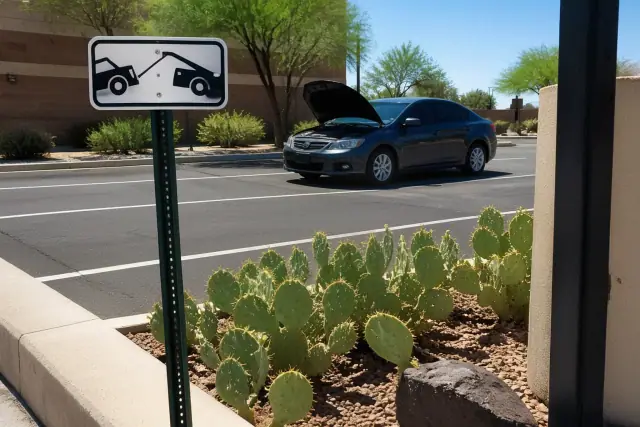
The towing company name and phone number posted at a private-lot entrance. The sign helps document whether Phoenix notice rules were followed.
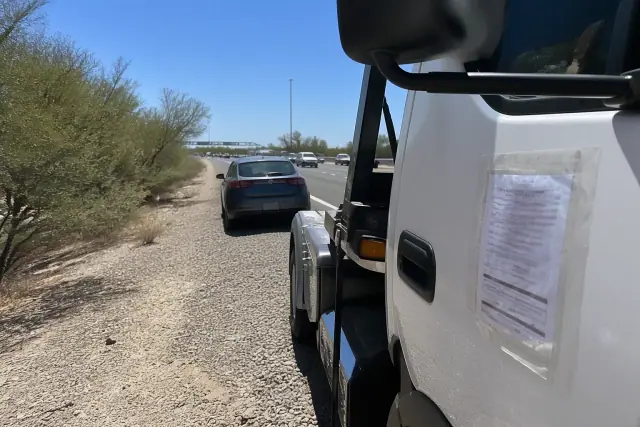
A plain tow-truck permit check with equipment and safety gear visible. Arizona DPS inspections cover equipment, signage, and insurance documentation.
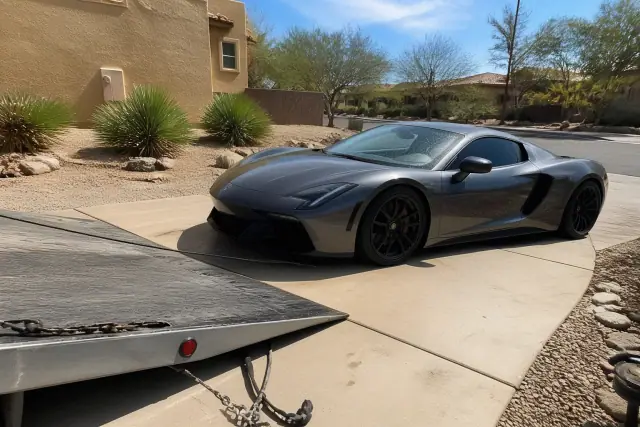
An all-wheel-drive or low-clearance vehicle secured on a flatbed. Phoenix pavement temperatures can exceed 150 degrees, making careful tire and undercarriage handling especially relevant.
Check the property owner's authorization, entrance signage, towing company contact details, and any city-specific notice or fee disclosures.
Phoenix police-ordered tows follow separate contract and impound procedures, and the storage facility may hold the vehicle until required fees are paid.
Bring photo ID, proof of ownership or insurance, and a card payment method. Personal belongings must be released free during business hours.
Towing requirements apply once roadside assistance hooks up a vehicle. Personal trailers also need a proper hitch, lights, safety chains, and brakes when the GVWR threshold applies.
| Situation | Main Rule | Practical Check |
|---|---|---|
| Private-property removal | A.R.S. 9-499.05 and local sign or notice rules | Photograph entrance signs and record who authorized the tow. |
| Police-ordered tow | Phoenix contract and impound procedures | Confirm the ordering agency and storage facility before pickup. |
| Stored vehicle or belongings | A.R.S. 28-4847 release protections | Ask about owner or insurer authorization and free property retrieval during business hours. |
| Tow-truck operation | DPS permit and inspection requirements | Confirm current permitting and required documentation. |
| Personal trailer use | 65 mph cap and brakes over 3,000 lb GVWR | Check brakes, lights, hitch, and safety chains before travel. |
Arizona combines state statutes, DPS oversight, and city ordinances. DPS runs the Tow Service Program under A.R.S. 41-1830.51, while A.R.S. 28-1108 covers tow-truck permits and inspections. Phoenix separately regulates police-ordered and private-lot tows, so first determine who ordered the removal and where it occurred. Operating without a current inspection and permit can bring fines starting around $100-$150 per violation. Emergency recovery on I-17 or Loop 202 also follows police or DPS contract procedures designed to clear lanes safely.
Typical Phoenix-area pricing in the source is $75-$160 for a standard local tow of 0-10 miles, plus $2.50-$5 per additional mile; long-distance towing uses a base fee plus a per-mile rate. In certain cases, A.R.S. 28-4847 allows vehicle release for as little as $20, and it requires free personal-property retrieval during business hours. Storage fees accrue daily, while A.R.S. 28-4841 requires towing and storage cost disclosure through posted rates. Tucson's stated carrier office hours are 8 a.m.-6 p.m. Monday through Friday and 8 a.m.-noon Saturday.
Can a vehicle in front of a home be towed? Public-street removals depend on city notice and timing rules, so confirm the process with local police non-emergency dispatch before arranging a tow. To find a vehicle in Phoenix, first ask Phoenix Police whether the tow was police-ordered, then check the private lot's posted sign if it was not. For release, bring photo ID, proof of ownership or insurance, and a card payment method; personal property must be available free during business hours.
Share where the vehicle was taken from, who ordered the tow, and what paperwork you have. A local team can explain practical next actions; for legal advice or a dispute, consult the responsible agency or a qualified attorney.